Diplomacy and UN · Analysis
Switzerland and China at UNGA 81: two agendas in New York
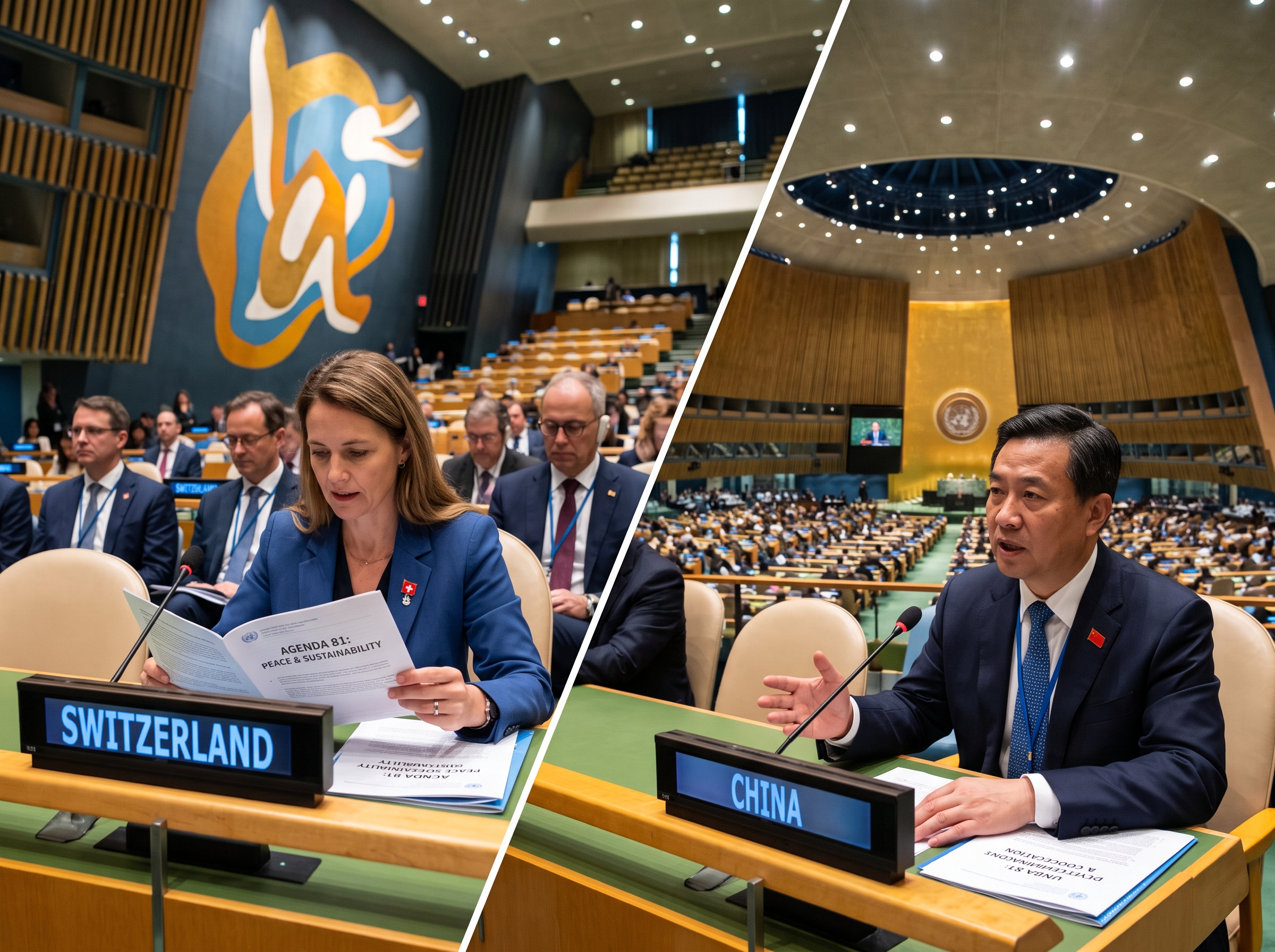
Switzerland and China both defended multilateral action at the UN General Assembly, but from different national positions. Their speeches are best read separately: Switzerland emphasised dialogue, open exchange and International Geneva; China set out a broader platform on security, development, trade and Global South representation.
At a glance
- Swiss President Guy Parmelin addressed the General Assembly on 22 September; Chinese Vice President Han Zheng spoke on 26 September.
- Both speeches supported multilateralism, dialogue, UN reform and wider access to the benefits of artificial intelligence.
- The similarities do not amount to a joint position. No official record reviewed for this article reports a Switzerland-China meeting at the assembly.
One assembly, two national messages
The 81st United Nations General Assembly opened under the theme “Restoring Trust, Managing Transformation: A United Nations That Delivers for All”. Switzerland and China each used the general debate to explain how they see that task, but they did so from different positions and with different priorities.
This is not a bilateral story. The official Swiss and Chinese records reviewed for this article do not report a meeting between the two delegations. The useful comparison lies in what each country chose to emphasise before the same international audience.
Switzerland: dialogue as a practical instrument
President Guy Parmelin built Switzerland’s address around the image of crossing mountains. His argument was that differences do not have to disappear before states can keep channels open. Switzerland presented dialogue as a tool for prevention and de-escalation, and restated its offer of good offices when parties are willing to use them.
That message was tied closely to International Geneva. Parmelin described Geneva as a place where governments, international organisations, science, humanitarian actors and civil society can meet without first agreeing. He also argued for open economic exchange. On international cooperation, he said it should not be used to impose one’s values or a single model, and that each country’s choices about its own future should be respected.
Artificial intelligence formed a second bridge in the speech. Parmelin warned that the technology could create a new divide between those able to shape it and those who experience only its consequences. He linked that concern to the Geneva AI Summit planned for June 2027 and to a wider call for trustworthy innovation.
On UN reform, Switzerland supported the UN80 initiative and called for a more coherent, effective and results-oriented organisation. The emphasis was institutional and practical: multilateralism should be judged by whether it improves people’s lives, not by the existence of institutions alone.
The wider Swiss programme in New York added a more immediate diplomatic layer. Foreign Minister Ignazio Cassis focused his meetings on the Middle East and Gulf, European security and the Sahel, while also calling for stronger operational protection of humanitarian personnel.
China: security, development and a stronger Global South voice
Vice President Han Zheng organised China’s address around four proposals. The first called for the postwar international order and the UN-centred system to be upheld, disputes to be handled through dialogue and consultation, and unilateral military actions that violate the UN Charter and circumvent Security Council authorisation to be opposed. The speech also stated China’s positions on the Middle East, Ukraine and Cuba.
The second proposal put development at the centre of the international agenda. Han called for priority to poverty reduction, food security and energy transition and more support for the Global South, and urged developed countries to honour their development and climate finance commitments. He opposed protectionism and disruption of supply chains, and supported a WTO-centred, rules-based multilateral trading system and an open world economy.
China also placed artificial intelligence within the development argument. The speech called for a people-centred approach, beneficial uses of AI and efforts to narrow the digital divide. Its third proposal addressed dialogue between civilisations and respect for countries’ chosen development paths.
The fourth proposal backed multilateralism, UN reform and a larger voice for the Global South. Han argued that UN80 should improve the performance of UN bodies rather than simply reduce budgets and mandates. He also marked 55 years since the General Assembly adopted Resolution 2758 and presented China’s peacekeeping, development and Global Development Initiative record as evidence of its international role.
Where the messages meet - and where they do not
There is visible overlap in vocabulary. Both speeches defended dialogue, an open international economy, responsible access to AI, multilateral institutions and reform of the UN system. For readers following Switzerland-China relations, that overlap identifies subjects on which both governments want to be heard internationally.
It does not establish policy alignment. Switzerland framed its case through good offices, International Geneva, institutional effectiveness and a bridge between innovation and trust. China placed its four global initiatives, development priorities, positions on current conflicts and greater Global South representation inside a broader account of the international order.
The distinction matters. Similar words can carry different diplomatic purposes, legal interpretations and policy expectations. A careful reading records the parallel themes without turning them into agreement.
What readers should watch next
For Switzerland, the clearest tests will be whether its New York diplomacy produces identifiable mediation work, practical measures to protect humanitarian personnel, or concrete outcomes from UN80 and the 2027 Geneva AI Summit process.
For China, readers can watch how its four proposals appear in UN negotiations, development projects, positions on specific conflicts and proposals for institutional reform. Claims about funding, representation or programme results should be checked against UN records and project-level evidence as they develop.
For the bilateral relationship, the next step is not to infer cooperation from two speeches. It is to look for a named Switzerland-China meeting, joint statement, programme or follow-up action from the responsible institutions. None was identified in the official UNGA records reviewed here.
How this is useful to our readers
For diplomats, policy professionals and international-affairs students, the article offers a compact way to compare national positioning without mistaking shared vocabulary for a joint policy. The linked official UN session record and full national statements make it possible to check the framing against the original record.
For universities, researchers and technology organisations, the speeches identify issues worth monitoring rather than immediate opportunities. These include the Geneva AI Summit process, inclusive AI governance, UN80 reform and the way development priorities are translated into named programmes. A speech is a signal of direction, not an application call or funding decision.
For companies and trade organisations, both addresses defend forms of economic openness, but neither creates a new market-access rule. Readers should continue to rely on formal WTO records, national regulations and published bilateral agreements before making operational decisions.
For people working directly on Switzerland-China relations, the practical value is a comparison baseline. Future claims of bilateral cooperation can be tested against these two national agendas and the Desk’s existing diplomacy background. A bilateral development should be supported by a named meeting, joint document or action from the responsible institutions.
Editorial note
This article compares two official national statements delivered at the same UN General Assembly. It does not claim a bilateral meeting, joint position or agreement.
Descriptions of national priorities are attributed to the relevant official records. The comparative reading is The Bridgewire analysis. Sources were checked on 1 October 2026.
Sources and further reading
- Swiss FDFA mission: President Guy Parmelin's official UNGA 81 speech, 22 September 2026 (PDF)
- FDFA: Switzerland advocates dialogue in a fragmented world, 24 September 2026
- Chinese Mission to the UN: Vice President Han Zheng's UNGA 81 statement, 26 September 2026
- Chinese Mission to the UN: official Chinese text of Vice President Han Zheng's UNGA 81 statement, 26 September 2026
- Chinese Ministry of Foreign Affairs: official Chinese readout of Han Zheng's address, 27 September 2026
- United Nations: 81st session of the General Assembly